
Introduction
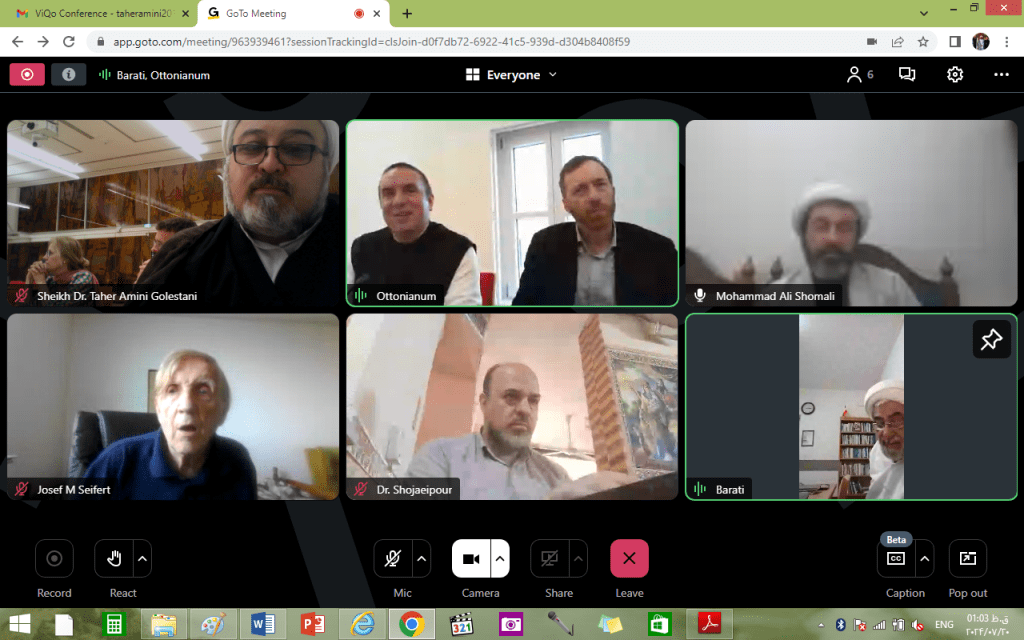
The Vienna-Qom Circle for Catholic-Shi’a Dialogue on Religion, Philosophy and Political Theory (ViQo Circle) brings together Christian scholars from Europe and Muslim scholars from Iran to exchange ideas and develop friendships. Regular meetings take place every two years— the venue alternating between Iran and Europe. This year the meeting took place July 19-21 in Heiligenkreuz, Austria, with a number of participants present, and others joining via video link.
The theme of this year’s meeting was “Religion and Political Justice in Shi’a and Catholic Thought.” In the opening panel on July 20th, ViQo founders Dr. Christian Machek (Vienna) and Sheikh Dr. Taher Amini Golestani (Qom) introduced the theme of the conference. They pointed out that justice is a key theme in both Catholic and Shi’a thought, and current conflicts both in Europe and in the Middle East show the urgency of the search for justice between nations, which must be founded on justice in individual souls.
Philosophical and Theological Perspectives
The next day (July 20th) began with a panel on philosophical and theological perspectives on the nature of justice. Sheikh Dr. Mohammad Ali Shomali joined via video link from the holy city of Qom in central Iran to give a presentation. He argued that a balanced approach to human life must include rationality, spirituality, and concern for social justice. Rationality alone does not suffice without spirituality, nor do either of those suffice without a practical concern for social justice. The concern for social justice is inspired by a spirituality that recognizes the justice of God. Dr. Shomali pointed out that God’s justice is not understood as arbitrary by the Shi’a tradition. Unlike some Ash’arite thinkers, who think that justice is simply defined by the divine will, Shi’a thinkers argue that there must be an objective content to justice, or else it would be meaningless to say that God is just.
Pater Dr. Edmund Waldstein OCist (Heiligenkreuz) then spoke on the virtue of justice and the virtue of religion. He argued that justice is a quality that enables human persons to will the good that is due to another. The virtue of religion is related to justice, since in religion we render to God the the reverence and worship due to Him. Human beings are bound to render God His due not only as individuals, but also as societies. Pater Edmund referred to arguments by St Augustine and Pope Leo XIII according to which political communities must recognize the true God and render Him true worship. According to Leo XIII, a society which refuses to give God His due, will certainly not give human beings their due.
Sheikh Dr. Mohammad Ali Savadi (Iran) was not able to be present, his presentation was therefore read for him by Sheikh Dr. Taher Amini Golestani. Dr. Savadi’s presentation focused the dangers posed by secularism, which wants to understand the world without reference to God. Secular ideologies have failed to secure justice for human beings. He argued that the fullness of justice can only be fully secured if divine revelation is accepted.
Finally, Dr. Jonathan Greig (Belgium) compared the account of justice in Plato’s Laws with the account of the building of the cosmos in Plato’s Timaeus. In both cases, he argued, a divine paradigm is used, but it cannot be perfectly copied in the material world. The contemplation of the true form of justice helps in the building of the city, but the city is always has imperfections, details, and concessions to material circumstances that cannot be found in the paradigm.

Political and Juridical Perspectives
A second panel on July 20th focused on political and juridical perspectives on justice. Dr. Adrian Hollaender (Vienna) expounded the various ways of defining justice. He explained Aristotle’s distinctions between general (legal) justice and particular justice, as well as the two kinds of particular justice—distributive and corrective. He showed how some modern approaches contradict Aristotle. For example, Aristotle thought that distributive justice consists in distributing goods according to merit in the community, so that it is just for the aristoi (the most excellent citizens) to receive more than the common people, but for Karl Marx distribution should be made according to need, so an aristocratic order as envisioned by Aristotle would be unjust. Practically speaking, Dr. Hollaender argued there will be disagreements about what is just. The role of the jurist is to find concrete solutions to disputes about justice, based on fair procedures, even if both sides in a dispute end up unsatisfied. In the Q&A Dr. Hollaender applied this view to the question of the war in Ukraine, arguing that both sides will have to give up something of what they think is their due to come to a practical solution.
Prof. Dr. Muhammad Hadi Moffateh, Head of Islamic Center of Hamburg, Germany, then gave a presentation via video link in which he argued that a close connection must be maintained between ethics and politics in order to secure political justice. The amoral political thought of thinkers such as Machiavelli must be rejected. Imam Ali, the son in law of the Prophet Muhammad, whom Shi’a believers revere as the Prophet’s true successor, is an example of someone who never compromised ethical principles for the sake of political expediency.
Prof Dr. Heinz Theissen (Germany) then gave a presentation via video link. He focused on the conflict in Palestine/Israel. He argued that in the short term peace must be founded on coexistence of different religions. In the long term, he argued, peace will only be possible if intransigent territorial demands, based on religious doctrine, are moderated by religious humility. The clash of civilizations must give way to a fight for civilization. Instead of pursuing eschatological goals by violent conflict, believers should cooperate to help each other supply the necessities of temporal life. The Abraham Accords represent a paradigm shift, which is a hope for peace. Hamas’s actions represent a rejection of that paradigm shift. Instead of conflict based on absolutizing beliefs we should seek cooperation based on a common recognition of needs. Absolutization of beliefs is not unique to religious believers, even humanists fall into this temptation; they see nothing greater than man, but then they absolutize man, turning him from a creature in to a creator, as manifested in gender ideology.
Dr. Christian Machek concluded the panel with further reflections on the nature of justice. He pointed out that the philosophical account of justice in Plato has influenced both Christian and Muslim thinkers. An objective understanding of the justice is necessary to avoid manipulation, it has a divine, social and individual dimension. Man ought to participate in the divine understanding of justice in order to be just, of which the Bible clearly refers to: to be a zaddik as Judaism refers to – we are part of a covenant with God and are called to live up to his will and his commandments. The fruit of true justice is peace, which is especially needed in the Holy Land.
Conclusion
In the concluding panel Dr. Shahram Shojaeepour (Qom) discussed Imam Ali as exemplar of just leadership. The personal justice of leaders is necessary to bring about a just society.
Sheikh Dr. Taher Amini Golestani then made his concluding remarks. It is not enough to discuss theoretical definitions of justice, he argued. The problems of justice throughout the world require practical solutions. We need an inter-religious coalition for peace and conflict resolution to help combat the injustices of our time. A model for such a coalition can be found in the Constitution of Medina, in which the Prophet provided for cooperation between religions in securing a just society. Dr. Amini proposed that the next ViQo circle should focus on such a coalition.
Finally Dr. Christian Machek gave closing remarks in which he summarized some of the most important points of the conference.
Cultural Program
After the conference some of the participants visited the Austrian pilgrimage shrine of Mariazell in the Styrian mountains. Sheikh Dr. Taher Amini Golestani expressed his gratitude for an opportunity to experience this place of pilgrimage.


 ViQo Circle