Blog

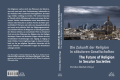
The Future of Faith in Secular Society: Proceedings of the 2020 ViQo Conference Published

The Proceedings of the 2020 ViQo Circle have been published by the Eos Verlag (Sankt Ottilien): Die Zukunft der Religion in säkularen Gesellschaften: The Future of Religion in Secular Societies. The volume includes contributions by Harald Bergbauer, Dušan Dostanić, David Engels, Daniel Führung, Taher Amini Golestani, Stefan Lakonig, Christian Machek, Corinna Mühlstedt, Katarzyna Parzych-Blakiewicz, Harald Seibert, Mohammed Ali Shomali, Heinz Theißen, Anna Varga-Jani, Edmund Waldstein, Yannic Weber, Michael Wladika, Notker Wolf, and Simon Wunder.
Statement Regarding Current Events
The ViQo Circle strongly condemns the unjust war of aggression against Iran and the assassination of His Eminence Imam Khamenei, Supreme Leader of Iran, and calls upon those responsible to repent and make restitution for this injustice.
The Catholic Church has consistently taught that war can only be just if strict criteria, founded in natural law, are fulfilled. In particular, war must be waged for a just cause, declared by the proper legal authority, and can only be undertaken after the exhaustion of all other remedies and with a reasonable expectation of success without causing worse disorder.
The current war against Iran fails on all counts. First, there was no just cause. Iran did not attack the United States first, nor was there even an imminent threat of an attack. Second, proper legal authorization was not obtained, neither under U.S. law (the authorization of Congress was lacking) nor under international law (the authorization of the UN was also lacking). Third, other remedies had not been exhausted. Iran was in fact engaged in diplomatic negotiations with Western leaders about their differences. Finally, there is no reasonable expectation that the war will improve the situation without causing worse disorder. On the contrary, there is a very real risk of plunging the whole region into violent chaos that will cause untold suffering for millions of people.
These risks are considerably aggravated by the targeted killing of Imam Khamenei. The deliberate killing of a religious and political leader outside the context of a just and lawful war constitutes a grave moral disorder. Regardless of the ideological differences among the parties involved, the intentional taking of human life as a political tool cannot be reconciled with the natural law tradition upheld by the Church.
Political authority, even when exercised imperfectly, is understood to derive ultimately from God. The Church clearly distinguishes between legitimate resistance to tyranny and acts of murder motivated by ideology or geopolitical calculation. The violent removal of a head of state – especially one who holds both political and religious authority – significantly increases the risk of chaos within Iran and heightened conflict in the Middle East and beyond.
Western leaders should hesitate to assume that they have the moral high ground over leaders in other countries. The common opinion in other parts of the world that the West is suffering from an epidemic of moral decadence is only strengthened by the willingness of Western leaders to engage in hubristic wars of aggression. Under such circumstances, European countries should at least remain neutral in this conflict.
Catholics, Muslims, Jews, and all persons of good will are bound to uphold the sanctity of life and the primacy of moral law over political strategy. True peace and justice cannot be built upon unjust killing. We join all persons of good will in praying for peace.
2024 ViQo Conference Takes Place in Austria
Introduction
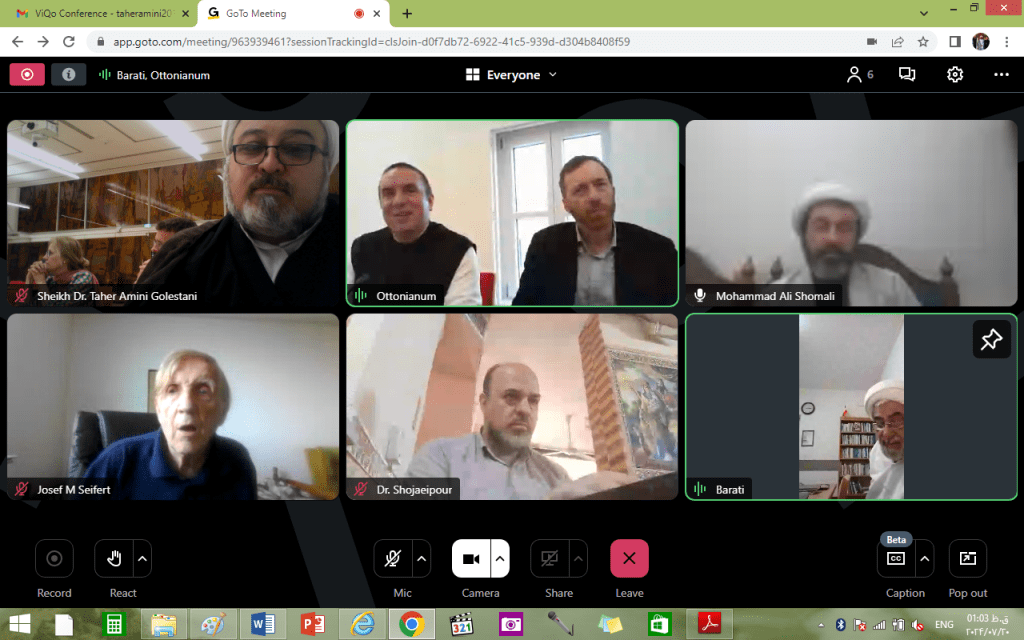
The Vienna-Qom Circle for Catholic-Shi’a Dialogue on Religion, Philosophy and Political Theory (ViQo Circle) brings together Christian scholars from Europe and Muslim scholars from Iran to exchange ideas and develop friendships. Regular meetings take place every two years— the venue alternating between Iran and Europe. This year the meeting took place July 19-21 in Heiligenkreuz, Austria, with a number of participants present, and others joining via video link.
The theme of this year’s meeting was “Religion and Political Justice in Shi’a and Catholic Thought.” In the opening panel on July 20th, ViQo founders Dr. Christian Machek (Vienna) and Sheikh Dr. Taher Amini Golestani (Qom) introduced the theme of the conference. They pointed out that justice is a key theme in both Catholic and Shi’a thought, and current conflicts both in Europe and in the Middle East show the urgency of the search for justice between nations, which must be founded on justice in individual souls.
Philosophical and Theological Perspectives
The next day (July 20th) began with a panel on philosophical and theological perspectives on the nature of justice. Sheikh Dr. Mohammad Ali Shomali joined via video link from the holy city of Qom in central Iran to give a presentation. He argued that a balanced approach to human life must include rationality, spirituality, and concern for social justice. Rationality alone does not suffice without spirituality, nor do either of those suffice without a practical concern for social justice. The concern for social justice is inspired by a spirituality that recognizes the justice of God. Dr. Shomali pointed out that God’s justice is not understood as arbitrary by the Shi’a tradition. Unlike some Ash’arite thinkers, who think that justice is simply defined by the divine will, Shi’a thinkers argue that there must be an objective content to justice, or else it would be meaningless to say that God is just.
Pater Dr. Edmund Waldstein OCist (Heiligenkreuz) then spoke on the virtue of justice and the virtue of religion. He argued that justice is a quality that enables human persons to will the good that is due to another. The virtue of religion is related to justice, since in religion we render to God the the reverence and worship due to Him. Human beings are bound to render God His due not only as individuals, but also as societies. Pater Edmund referred to arguments by St Augustine and Pope Leo XIII according to which political communities must recognize the true God and render Him true worship. According to Leo XIII, a society which refuses to give God His due, will certainly not give human beings their due.
Sheikh Dr. Mohammad Ali Savadi (Iran) was not able to be present, his presentation was therefore read for him by Sheikh Dr. Taher Amini Golestani. Dr. Savadi’s presentation focused the dangers posed by secularism, which wants to understand the world without reference to God. Secular ideologies have failed to secure justice for human beings. He argued that the fullness of justice can only be fully secured if divine revelation is accepted.
Finally, Dr. Jonathan Greig (Belgium) compared the account of justice in Plato’s Laws with the account of the building of the cosmos in Plato’s Timaeus. In both cases, he argued, a divine paradigm is used, but it cannot be perfectly copied in the material world. The contemplation of the true form of justice helps in the building of the city, but the city is always has imperfections, details, and concessions to material circumstances that cannot be found in the paradigm.

Political and Juridical Perspectives
A second panel on July 20th focused on political and juridical perspectives on justice. Dr. Adrian Hollaender (Vienna) expounded the various ways of defining justice. He explained Aristotle’s distinctions between general (legal) justice and particular justice, as well as the two kinds of particular justice—distributive and corrective. He showed how some modern approaches contradict Aristotle. For example, Aristotle thought that distributive justice consists in distributing goods according to merit in the community, so that it is just for the aristoi (the most excellent citizens) to receive more than the common people, but for Karl Marx distribution should be made according to need, so an aristocratic order as envisioned by Aristotle would be unjust. Practically speaking, Dr. Hollaender argued there will be disagreements about what is just. The role of the jurist is to find concrete solutions to disputes about justice, based on fair procedures, even if both sides in a dispute end up unsatisfied. In the Q&A Dr. Hollaender applied this view to the question of the war in Ukraine, arguing that both sides will have to give up something of what they think is their due to come to a practical solution.
Prof. Dr. Muhammad Hadi Moffateh, Head of Islamic Center of Hamburg, Germany, then gave a presentation via video link in which he argued that a close connection must be maintained between ethics and politics in order to secure political justice. The amoral political thought of thinkers such as Machiavelli must be rejected. Imam Ali, the son in law of the Prophet Muhammad, whom Shi’a believers revere as the Prophet’s true successor, is an example of someone who never compromised ethical principles for the sake of political expediency.
Prof Dr. Heinz Theissen (Germany) then gave a presentation via video link. He focused on the conflict in Palestine/Israel. He argued that in the short term peace must be founded on coexistence of different religions. In the long term, he argued, peace will only be possible if intransigent territorial demands, based on religious doctrine, are moderated by religious humility. The clash of civilizations must give way to a fight for civilization. Instead of pursuing eschatological goals by violent conflict, believers should cooperate to help each other supply the necessities of temporal life. The Abraham Accords represent a paradigm shift, which is a hope for peace. Hamas’s actions represent a rejection of that paradigm shift. Instead of conflict based on absolutizing beliefs we should seek cooperation based on a common recognition of needs. Absolutization of beliefs is not unique to religious believers, even humanists fall into this temptation; they see nothing greater than man, but then they absolutize man, turning him from a creature in to a creator, as manifested in gender ideology.
Dr. Christian Machek concluded the panel with further reflections on the nature of justice. He pointed out that the philosophical account of justice in Plato has influenced both Christian and Muslim thinkers. An objective understanding of the justice is necessary to avoid manipulation, it has a divine, social and individual dimension. Man ought to participate in the divine understanding of justice in order to be just, of which the Bible clearly refers to: to be a zaddik as Judaism refers to – we are part of a covenant with God and are called to live up to his will and his commandments. The fruit of true justice is peace, which is especially needed in the Holy Land.
Conclusion
In the concluding panel Dr. Shahram Shojaeepour (Qom) discussed Imam Ali as exemplar of just leadership. The personal justice of leaders is necessary to bring about a just society.
Sheikh Dr. Taher Amini Golestani then made his concluding remarks. It is not enough to discuss theoretical definitions of justice, he argued. The problems of justice throughout the world require practical solutions. We need an inter-religious coalition for peace and conflict resolution to help combat the injustices of our time. A model for such a coalition can be found in the Constitution of Medina, in which the Prophet provided for cooperation between religions in securing a just society. Dr. Amini proposed that the next ViQo circle should focus on such a coalition.
Finally Dr. Christian Machek gave closing remarks in which he summarized some of the most important points of the conference.
Cultural Program
After the conference some of the participants visited the Austrian pilgrimage shrine of Mariazell in the Styrian mountains. Sheikh Dr. Taher Amini Golestani expressed his gratitude for an opportunity to experience this place of pilgrimage.

Conference: Religion and Political Justice in Shi’a and Catholic Thought, July 19th -21st, 2024
Critics of religion often see it as an obstacle to political justice, as “opium for the people” that prevents them from rebelling against unjust exploitation, or as a system of oppression in itself. But great religious thinkers have seen religion as being at the heart of justice, including in the political realm. Imam Khomeini, writing to the leader of the Soviet Union asked rhetorically, “Is the religion that seeks the administration of justice in the world and man’s freedom from material and spiritual shackles, the opium of the people?” (In Catholic Social Teaching the link between religion (as the justice owed to God) and political justice (as what is owed to our fellow men) is well established. As Pope Leo XIII wrote “As soon as the State refuses to give to God what belongs to God, by a necessary consequence it refuses to give to citizens that to which, as men, they have a right.” The 2024 ViQo Circle Conference will illuminate the theme of justice from the perspective of Shi’a Islam and Catholic Christianity.
Webinar: Commemoration of Historical Meeting of Grand Ayatullah Seyed Ali Sistani and His Holiness Pope Francis
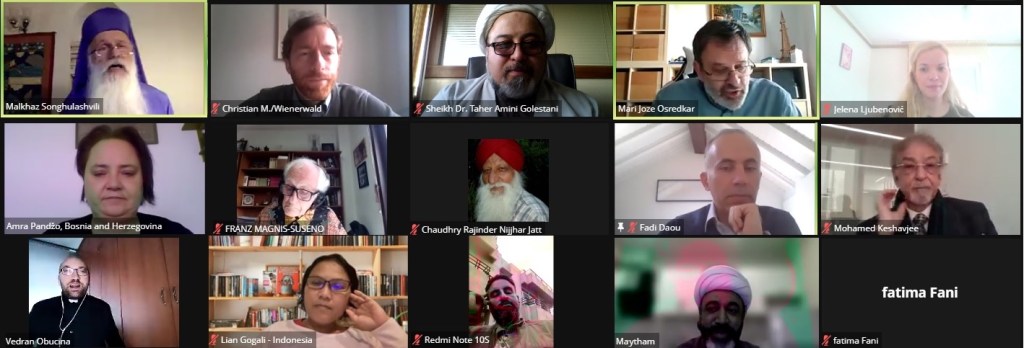
On February 28th, 2022, the International Institute for Peace and Religions, Qom, Iran and the ViQo Circle held a Webinar on Islamic-Christian Dialogue with a commemoration of historic meeting of Grand Ayatullah Seyed Ali Sistani and His Holiness Pope Francis, which took place one year previously (March 6th, 2021). Moderated by Sheikh Dr. Taher Amini Golestani, the webinar brought together a number of speakers from both the Muslim and the Christian world, who spoke about the significance of the meeting between Grand Ayatullah Sistani and Pope Francis, and about the future of Muslim-Christian dialogue, and the future of faith in secular societies.
2020 ViQo Conference Schedule: “The Future of Faith in Secular Society”
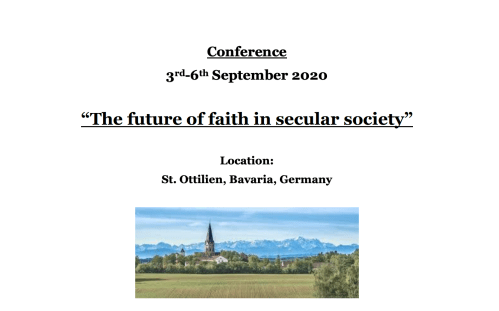
The 2020 ViQo Conference will take place 3rd-6th September, 2020 in St. Ottilien, Bavaria, Germany. The schedule can be found here.
Concepts of Order
by Dr. Christian Machek
Since time religions have given people answers to the essential questions of life – including those that regard living together. Let us be reminded of to the so-called “Golden Rule”, which is found in many religions. We might also recall the Catholic Social Teaching, which in the course of recent history gave and still gives answers to questions and problems of human coexistence in view of numerous social and political challenges. It should not go unmentioned that Islam sees itself as a political religion – religion and politics are inseparably linked to each other in Islam. The always relevant answers of the different world religions to the questions of living together are based on different and differentiated philosophical-theological concepts. But despite all these differences, are there not similarities that need to be worked out and made fruitful for the present in the face of a growing global heterogeneity and global challenges? (more…)
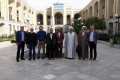
ViQo Circle 3rd Meeting
The 3rd Meeting of the ViQO Circle was held between 4-14 April 2019 in the Institute for Peace and Religions of Qom, Islamic Republic of Iran. The following report is taken from the Institute for Peace and Religions website.
The main theme of the conference was “Religion, Politics and the State. An Attempt to Clarify a Challenging Relationship” and professors from the Catholic University of Cologne as well as Vienna University took part.
The program had two main parts of cultural and scholarly: ViQo Circle 3rd Round of Dialogue in Iran.
The sub-topics of the participates were:
- Tuesday Afternoon, 16:00, 2019/4/9
- Reflections about the coexistence between secular and religious cultures, by Prof. Dr. Heinz Theisen, Catholic University of North Rhine-Westphalia Catholic University of Applied Science, Cologne, Germany
- The Relation between Politics & Religion in Iran, (a Historical and Theoretical Study (by Dr. Sh. Shojaeipour, The head of policy making Dep. at IIPR and Professor of History, Law &Political Studies
- Ethnic Segregation within Cities, Structure, development and role of social work, by Dr. Schoenig Andreas Werner
Catholic University of North Rhine-Westphalia Catholic University of Applied Science, Cologne, Germany
- The relation between Europe and the Islamic Republic of Iran: the desirable pattern, By Sheikh M.A.Savadi, Professor in Al-Mustafa International University, Member of Policy Making Department, IIPR
- Wednesday Afternoon, 16:00, 2019/4/10
- The Modern Democratic Constitutional State, as a Protective Order of Freedom, beyond Profanity andFundamentalism, by Prof. Dr Armin Gunther Wildfeuer ,Catholic University of North Rhine-Westphalia Catholic University of Applied Science, Cologne, Germany
- Christian Muslim Relationship and Future of Faith in Secular Societies, by Hujjatul Islam Sheikh Dr. Shomali, Director of International Institute for Islamic Studies, Imam and Director of Islamic Center in London, England
- Religious Government and Governance of Jurist (“Wilayat al-Faqih ”) Shia Political Thought, Sheikh Dr. Taher Amini Golestai, Director of Institute for Peace and Religions of Qom, Professor in Al-Mustafa International University


ViQo Conference Proceedings Published
 The proceedings of the 2016 ViQo Conference have been edited by Stefan Gugerel, Christian Machek, and Clemens Egger, and published by the Institut für Religion und Frieden, as an official publication of the Republic of Austria, with the title Ordnungskonzeptionen für die Zukunft: Impulse aus schiitischer, orthodoxer und katholischer Tradition [Conceptions of Order for the Future: Proposals from the Shi’a, Orthodox, and Catholic Traditions].
The volume includes essays from Christian and Muslim perspectives on such topics as the natural law and its relation to revealed law; freedom, autonomy and theonomy; the dialogue of faiths and cultures; and the relation of religion and politics. Despite their differences, the essays show points of convergence and common concern between Christian and Muslim thought.
The conference was held in Vienna in cooperation with the Johannes-Messner-Gesellschaft, the Institut für Religion und Frieden of the Austrian Military Diocese, the The International Institute for Peace and Religions, and the Al-Hikmah Institute of A-Mustafa International University.
The cover and table of contents of the volume can be downloaded here.
The Relationship between State and Religion in Europe
A Sketch
by Harald Bergbauer
The topic of the relationship between state and religion in Europe is obviously very ample and comprehensive. It is evident, too, that the topic is to some extent vague, a condition that allows for a global survey. Religion and the divine in different shapes accompany all human history, and man was perennially looking for adequate ways to express his relationship to God and the divine. With regard to the three monotheistic world religions Judaism, Christianity, and Islam, the Old Testament bears already witness of the relationship between state and religion. The New Testament and the subsequent history of occidental Europe build first on that basis, but then distance themselves considerably from it. The following essay gives an outline of that relationship, stressing both continuities and differences. (more…)
Featured Posts
-
Statement Regarding Current Events
The ViQo Circle strongly condemns the unjust war of aggression against Iran and the assassination of His Eminence Imam Khamenei, Supreme Leader of Iran, and…
-
2024 ViQo Conference Takes Place in Austria
Introduction The Vienna-Qom Circle for Catholic-Shi’a Dialogue on Religion, Philosophy and Political Theory (ViQo Circle) brings together Christian scholars from Europe and Muslim scholars from…
-
Conference: Religion and Political Justice in Shi’a and Catholic Thought, July 19th -21st, 2024
Critics of religion often see it as an obstacle to political justice, as “opium for the people” that prevents them from rebelling against unjust exploitation,…
-
Webinar: Commemoration of Historical Meeting of Grand Ayatullah Seyed Ali Sistani and His Holiness Pope Francis
On February 28th, 2022, the International Institute for Peace and Religions, Qom, Iran and the ViQo Circle held a Webinar on Islamic-Christian Dialogue with a…
 ViQo Circle