Home » Conferences
Category Archives: Conferences
2024 ViQo Conference Takes Place in Austria
Introduction
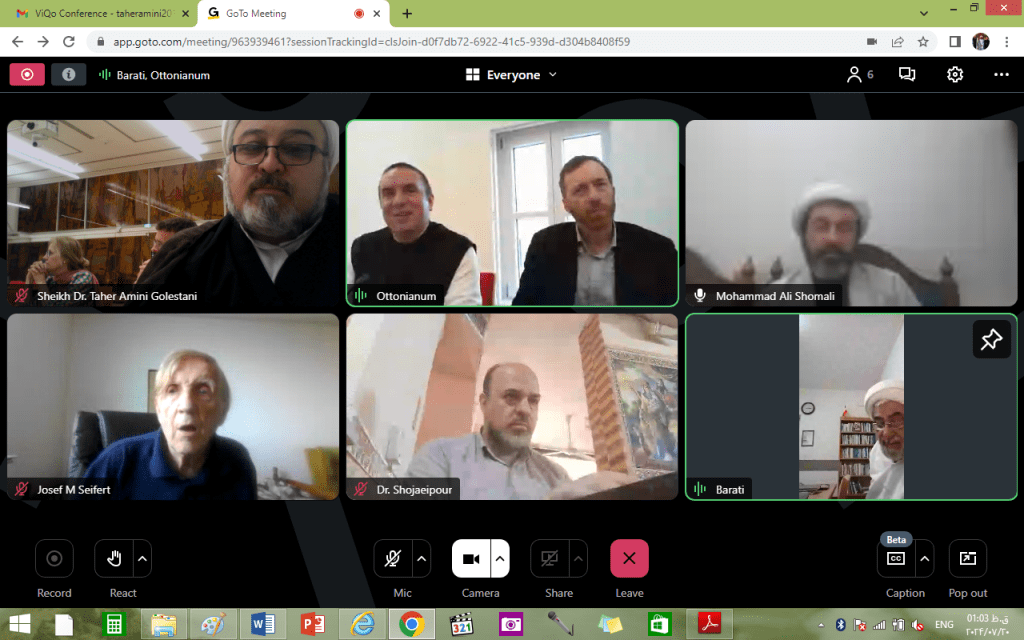
The Vienna-Qom Circle for Catholic-Shi’a Dialogue on Religion, Philosophy and Political Theory (ViQo Circle) brings together Christian scholars from Europe and Muslim scholars from Iran to exchange ideas and develop friendships. Regular meetings take place every two years— the venue alternating between Iran and Europe. This year the meeting took place July 19-21 in Heiligenkreuz, Austria, with a number of participants present, and others joining via video link.
The theme of this year’s meeting was “Religion and Political Justice in Shi’a and Catholic Thought.” In the opening panel on July 20th, ViQo founders Dr. Christian Machek (Vienna) and Sheikh Dr. Taher Amini Golestani (Qom) introduced the theme of the conference. They pointed out that justice is a key theme in both Catholic and Shi’a thought, and current conflicts both in Europe and in the Middle East show the urgency of the search for justice between nations, which must be founded on justice in individual souls.
Philosophical and Theological Perspectives
The next day (July 20th) began with a panel on philosophical and theological perspectives on the nature of justice. Sheikh Dr. Mohammad Ali Shomali joined via video link from the holy city of Qom in central Iran to give a presentation. He argued that a balanced approach to human life must include rationality, spirituality, and concern for social justice. Rationality alone does not suffice without spirituality, nor do either of those suffice without a practical concern for social justice. The concern for social justice is inspired by a spirituality that recognizes the justice of God. Dr. Shomali pointed out that God’s justice is not understood as arbitrary by the Shi’a tradition. Unlike some Ash’arite thinkers, who think that justice is simply defined by the divine will, Shi’a thinkers argue that there must be an objective content to justice, or else it would be meaningless to say that God is just.
Pater Dr. Edmund Waldstein OCist (Heiligenkreuz) then spoke on the virtue of justice and the virtue of religion. He argued that justice is a quality that enables human persons to will the good that is due to another. The virtue of religion is related to justice, since in religion we render to God the the reverence and worship due to Him. Human beings are bound to render God His due not only as individuals, but also as societies. Pater Edmund referred to arguments by St Augustine and Pope Leo XIII according to which political communities must recognize the true God and render Him true worship. According to Leo XIII, a society which refuses to give God His due, will certainly not give human beings their due.
Sheikh Dr. Mohammad Ali Savadi (Iran) was not able to be present, his presentation was therefore read for him by Sheikh Dr. Taher Amini Golestani. Dr. Savadi’s presentation focused the dangers posed by secularism, which wants to understand the world without reference to God. Secular ideologies have failed to secure justice for human beings. He argued that the fullness of justice can only be fully secured if divine revelation is accepted.
Finally, Dr. Jonathan Greig (Belgium) compared the account of justice in Plato’s Laws with the account of the building of the cosmos in Plato’s Timaeus. In both cases, he argued, a divine paradigm is used, but it cannot be perfectly copied in the material world. The contemplation of the true form of justice helps in the building of the city, but the city is always has imperfections, details, and concessions to material circumstances that cannot be found in the paradigm.

Political and Juridical Perspectives
A second panel on July 20th focused on political and juridical perspectives on justice. Dr. Adrian Hollaender (Vienna) expounded the various ways of defining justice. He explained Aristotle’s distinctions between general (legal) justice and particular justice, as well as the two kinds of particular justice—distributive and corrective. He showed how some modern approaches contradict Aristotle. For example, Aristotle thought that distributive justice consists in distributing goods according to merit in the community, so that it is just for the aristoi (the most excellent citizens) to receive more than the common people, but for Karl Marx distribution should be made according to need, so an aristocratic order as envisioned by Aristotle would be unjust. Practically speaking, Dr. Hollaender argued there will be disagreements about what is just. The role of the jurist is to find concrete solutions to disputes about justice, based on fair procedures, even if both sides in a dispute end up unsatisfied. In the Q&A Dr. Hollaender applied this view to the question of the war in Ukraine, arguing that both sides will have to give up something of what they think is their due to come to a practical solution.
Prof. Dr. Muhammad Hadi Moffateh, Head of Islamic Center of Hamburg, Germany, then gave a presentation via video link in which he argued that a close connection must be maintained between ethics and politics in order to secure political justice. The amoral political thought of thinkers such as Machiavelli must be rejected. Imam Ali, the son in law of the Prophet Muhammad, whom Shi’a believers revere as the Prophet’s true successor, is an example of someone who never compromised ethical principles for the sake of political expediency.
Prof Dr. Heinz Theissen (Germany) then gave a presentation via video link. He focused on the conflict in Palestine/Israel. He argued that in the short term peace must be founded on coexistence of different religions. In the long term, he argued, peace will only be possible if intransigent territorial demands, based on religious doctrine, are moderated by religious humility. The clash of civilizations must give way to a fight for civilization. Instead of pursuing eschatological goals by violent conflict, believers should cooperate to help each other supply the necessities of temporal life. The Abraham Accords represent a paradigm shift, which is a hope for peace. Hamas’s actions represent a rejection of that paradigm shift. Instead of conflict based on absolutizing beliefs we should seek cooperation based on a common recognition of needs. Absolutization of beliefs is not unique to religious believers, even humanists fall into this temptation; they see nothing greater than man, but then they absolutize man, turning him from a creature in to a creator, as manifested in gender ideology.
Dr. Christian Machek concluded the panel with further reflections on the nature of justice. He pointed out that the philosophical account of justice in Plato has influenced both Christian and Muslim thinkers. An objective understanding of the justice is necessary to avoid manipulation, it has a divine, social and individual dimension. Man ought to participate in the divine understanding of justice in order to be just, of which the Bible clearly refers to: to be a zaddik as Judaism refers to – we are part of a covenant with God and are called to live up to his will and his commandments. The fruit of true justice is peace, which is especially needed in the Holy Land.
Conclusion
In the concluding panel Dr. Shahram Shojaeepour (Qom) discussed Imam Ali as exemplar of just leadership. The personal justice of leaders is necessary to bring about a just society.
Sheikh Dr. Taher Amini Golestani then made his concluding remarks. It is not enough to discuss theoretical definitions of justice, he argued. The problems of justice throughout the world require practical solutions. We need an inter-religious coalition for peace and conflict resolution to help combat the injustices of our time. A model for such a coalition can be found in the Constitution of Medina, in which the Prophet provided for cooperation between religions in securing a just society. Dr. Amini proposed that the next ViQo circle should focus on such a coalition.
Finally Dr. Christian Machek gave closing remarks in which he summarized some of the most important points of the conference.
Cultural Program
After the conference some of the participants visited the Austrian pilgrimage shrine of Mariazell in the Styrian mountains. Sheikh Dr. Taher Amini Golestani expressed his gratitude for an opportunity to experience this place of pilgrimage.

Webinar: Commemoration of Historical Meeting of Grand Ayatullah Seyed Ali Sistani and His Holiness Pope Francis
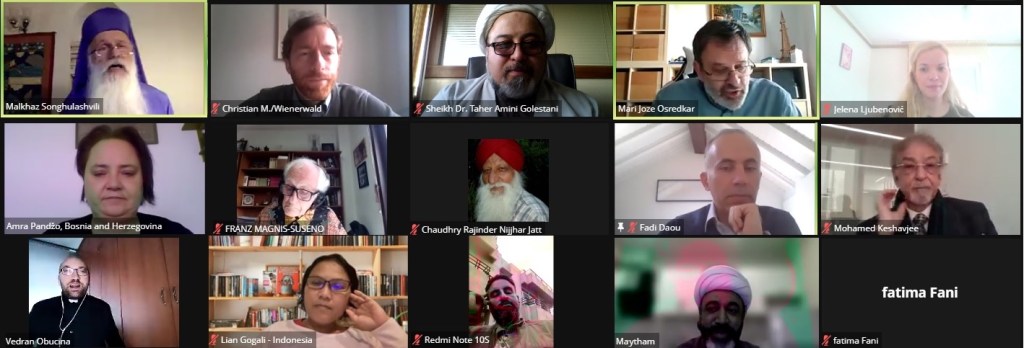
On February 28th, 2022, the International Institute for Peace and Religions, Qom, Iran and the ViQo Circle held a Webinar on Islamic-Christian Dialogue with a commemoration of historic meeting of Grand Ayatullah Seyed Ali Sistani and His Holiness Pope Francis, which took place one year previously (March 6th, 2021). Moderated by Sheikh Dr. Taher Amini Golestani, the webinar brought together a number of speakers from both the Muslim and the Christian world, who spoke about the significance of the meeting between Grand Ayatullah Sistani and Pope Francis, and about the future of Muslim-Christian dialogue, and the future of faith in secular societies.
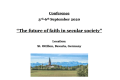
2020 ViQo Conference Schedule: “The Future of Faith in Secular Society”
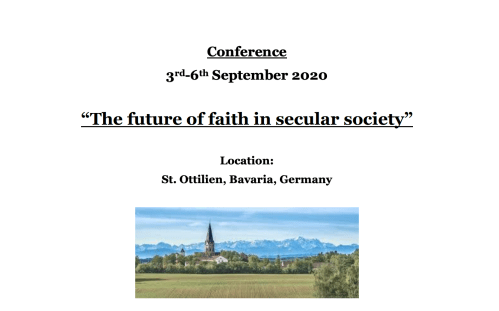
The 2020 ViQo Conference will take place 3rd-6th September, 2020 in St. Ottilien, Bavaria, Germany. The schedule can be found here.
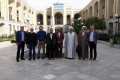
ViQo Circle 3rd Meeting
The 3rd Meeting of the ViQO Circle was held between 4-14 April 2019 in the Institute for Peace and Religions of Qom, Islamic Republic of Iran. The following report is taken from the Institute for Peace and Religions website.
The main theme of the conference was “Religion, Politics and the State. An Attempt to Clarify a Challenging Relationship” and professors from the Catholic University of Cologne as well as Vienna University took part.
The program had two main parts of cultural and scholarly: ViQo Circle 3rd Round of Dialogue in Iran.
The sub-topics of the participates were:
- Tuesday Afternoon, 16:00, 2019/4/9
- Reflections about the coexistence between secular and religious cultures, by Prof. Dr. Heinz Theisen, Catholic University of North Rhine-Westphalia Catholic University of Applied Science, Cologne, Germany
- The Relation between Politics & Religion in Iran, (a Historical and Theoretical Study (by Dr. Sh. Shojaeipour, The head of policy making Dep. at IIPR and Professor of History, Law &Political Studies
- Ethnic Segregation within Cities, Structure, development and role of social work, by Dr. Schoenig Andreas Werner
Catholic University of North Rhine-Westphalia Catholic University of Applied Science, Cologne, Germany
- The relation between Europe and the Islamic Republic of Iran: the desirable pattern, By Sheikh M.A.Savadi, Professor in Al-Mustafa International University, Member of Policy Making Department, IIPR
- Wednesday Afternoon, 16:00, 2019/4/10
- The Modern Democratic Constitutional State, as a Protective Order of Freedom, beyond Profanity andFundamentalism, by Prof. Dr Armin Gunther Wildfeuer ,Catholic University of North Rhine-Westphalia Catholic University of Applied Science, Cologne, Germany
- Christian Muslim Relationship and Future of Faith in Secular Societies, by Hujjatul Islam Sheikh Dr. Shomali, Director of International Institute for Islamic Studies, Imam and Director of Islamic Center in London, England
- Religious Government and Governance of Jurist (“Wilayat al-Faqih ”) Shia Political Thought, Sheikh Dr. Taher Amini Golestai, Director of Institute for Peace and Religions of Qom, Professor in Al-Mustafa International University


Conference Report by Christian Machek (German)
Bericht Interreligiöse Konferenz “Heute gerecht leben. Impulse zu Ordnungskonzeptionen aus katholischer, orthodoxer und schiitischer Tradition”
Dr. Christian Machek
Seit je her geben Religionen den Menschen Antworten auf die essentiellen Lebensfragen, auch bezüglich des Zusammenlebens. Diesen immer hoch aktuellen Antworten der verschiedenen Weltreligionen liegen historisch ausdifferenzierte philosophisch-theologische Konzepte zugrunde. Bestehen bei allen Unterschieden auch Gemeinsamkeiten, die es zu erkennen und für die Gegenwart fruchtbar zu machen gilt? Johannes Messner meinte, dass der Lehre vom Naturrecht und Naturgesetz im interreligiösen Gespräch größere Bedeutung denn je zukommen wird.
Der Frage nach der Bedeutung des Naturrechts und der Religion überhaupt ging die Messner-Gesellschaft in einer in Kooperation mit dem Institut für Religion und Frieden (unter der Leitung von MilSuperior MMag. Gugurel) veranstalteten Konferenz vom 19. bis 22. September 2016 nach. Der Titel der Konferenz lautete: „Heute gerecht leben“ und war ein Trialog zwischen katholischen, orthodoxen und schiitischen Gelehrten, indem insbesondere die Voraussetzungen für eine vernünftige Koexistenz und somit den Perspektiven für eine Kooperation in der heutigen Welt erörtert wurden. Die konkreten Themen der Konferenz waren Anthropologie, philosophische Traditionen, Religionsgeschichte, Ordnungskonzeptionen mit besonderer Bezugnahme auf das Verhältnis von Religion und Staat, der interreligiöse Dialog und eben die Frage nach einer Koexistenz und einer Kooperation der Religionen. Teilnehmer der Konferenz waren Professoren aus Österreich, der Bundesrepublik Deutschland und dem Iran, sowie Mitglieder der Messner-Gesellschaft.
Das Leitmotiv der Konferenz war die von Hans Küng formulierte Überzeugung: „Kein Frieden unter den Nationen ohne Frieden unter den Religionen. Kein Frieden unter den Religionen ohne Dialog zwischen den Religionen. Kein Dialog zwischen den Religionen ohne Grundlagenforschung in den Religionen.“ Die Religionen sind eine „Schule der göttlichen Gnade“, und im Zeichen der Suche nach gemeinsamen Wurzeln und einer gemeinsamen Wahrheit fand diese Konferenz und das anschließende Kulturprogramm – getragen von einem Geist der Offenheit, Wertschätzung und Freundschaft – statt, die einen intensiven, spannenden und fruchtbaren akademischen Diskurs ermöglichten. Teil des Programms waren auch Besuche bei Frau Dekanin Prof. Müller von der Theologischen Fakultät und dem islamischen Religionspädagogen Prof. Aslan von der Universität Wien sowie der Klöster Heiligenkreuz und Melk.
Im ersten Teil der Konferenz wurden die philosophischen und theologischen Grundlagen von Christentum und Islam erörtert. Es stellte sich heraus, dass der schiitische Islam über eine starke neoplatonische Tradition verfügt, betont er doch die Prinzipien Rationalität, Spiritualität und Gerechtigkeit. In einem gemeinsamen philosophischen Traditionsverständnis ist die Vernunft mit dem Ordnungsdenken verknüpft. Der Logos ist eben ein kosmischer Begriff. Es gibt eine Verbindung zwischen der Vernunft Gottes, der objektiven Vernünftigkeit der Welt, die wir „Natur“ nennen, und der endlichen Vernunft der Menschen. Dieses Konzept ist theonomisch und bis heute der Verdrängung durch ein autonomes Menschenbild ausgesetzt.
Das gemeinsame Verständnis der Unvollkommenheit des Menschen (mit dem Unterschied der christlichen Erbsündenlehre) bei seinem gleichzeitigen Streben nach Vollkommenheit wurde anfangs der Konferenz angesprochen. Der Mensch ist nicht bloßes Faktum, sondern ein Wesen, das seine Menschennatur entfaltet. Ein naturalistisches und voluntaristisches Menschenbild schaden dem Menschen und führen unweigerlich zu Chaos und Anarchie. Es gibt immer einen Maßstab für das menschliche Handeln „jenseits“ eines Konventionalismus. Die Grundlagen für den Begriff der Menschenwürde, sowie die unterschiedlichen religiösen und modernen Verständnisse von Freiheit wurden ferner thematisiert. Dabei betonten die iranischen Gäste, dass das Gewissen („innerer Prophet“) im Einklang mit der Offenbarung (der „äußeren Propheten“) stehen sollte.
Anknüpfend an diese Überlegungen zu den Grundsätzen wurde die Frage nach der Ordnung des Zusammenlebens gestellt. Kann es eine gesellschaftliche Ordnung ohne Gott geben? Ist es nicht vielleicht doch gerade die Religion, die die Würde des Menschen schützt – trotz ihrer Missbräuche und Pathologien, die angesprochen wurden (z. B. Gewaltbereitschaft im Islam)? Wie sieht dabei das Verhältnis von Religion und Staat aus bzw. sollte es aussehen? Der Islam kennt die Einheit der politischen und religiösen Sphären, das (katholische und orthodoxe) Christentum die Unterscheidung, aber nicht die Trennung im Sinne des säkularen bzw. laizistischen Staates. Staat und Kirche sind analog zu sehen mit dem Körper und der Seele des Menschen. In Deutschland und Österreich hat sich ein eigenes Modell entwickelt, dass die Freiheit des Einzelnen achtet und sichern will sowie gleichzeitig den Religionen einen geschützten Status in Staat und Gesellschaft garantiert. Das Bonner Grundgesetz beginnt etwa mit einer Verantwortungsklausel vor Gott.
In politikwissenschaftlichen Schlussbetrachtungen wurde festgehalten, dass unsere heutige Welt zunehmend multipolar ist und in dieser realpolitisch eine Ordnung der Welt möglich ist. Dabei sind diverse Universalismen und ihr „Export“, hinter dem sich meist Machtinteressen verbergen, als Gefahr für die Weltfrieden zu sehen. Die Religionen mit ihren Offenbarungen, aber auch ihrer Rationalität, können einen wichtigen Beitrag zur Lösung der Probleme der Menschheit liefern, so der Grundkonsens der Konferenz. Dabei kann der Andere ein Zeichen Gottes für uns sein, so der orthodoxe Referent. Sind wir fähig von anderen zu lernen, was wir vielleicht schon vergessen haben? Das Institut für Religion und Frieden wird einen Sammelband der Konferenz im nächsten Jahr herausgeben. Es wurde ein eigenes Dialog-Forum, den ViCo-Kreis, der Vienna-Qom Circle for Catholic-Shi’a Dialogue on Religion, Philosophy and Political Theory, gegründet. Und im Hinblick auf die Fortsetzung der bisherigen Tagungen wurde eine dritte Konferenz anberaumt, die voraussichtlich wieder in Qom (Iran) stattfinden wird. An unserem Dialog-Forum sind Sie selbstverständlich herzlich eingeladen teilzunehmen: https://viqocircle.org. Die Dialoge werden ihre Fortsetzung finden – so Gott will, Inshallah.


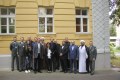
2016 Conference: Living Justly Today
Our September 2016 conference was held in Vienna in cooperation with the Johannes-Messner-Gesellschaft, the Institut für Religion und Frieden of the Austrian Military Diocese, the The International Institute for Peace and Religions, and the Al-Hikmah Institute of A-Mustafa International University, those last two based in Qom, Iran. The theme was the just ordering of human life and society from Catholic, Orthodox and Sh’ia perspectives. At the end of the conference it was decided to give our group the name “ViQo Circle ” short for “ViennaQom Circle.” (more…)
 ViQo Circle